The Obvious Choice Framework™
AI search has changed how patients choose dentists. Not just how they search. The Obvious Choice Framework is built on three fundamental shifts to ensure your practice is the one chosen by your ideal patients.
Patients have always chosen dentists based on preferences including insurance, location, expertise, technology, patient experience, and philosophy of care.
But until recently, the search process rarely reflected those preferences.
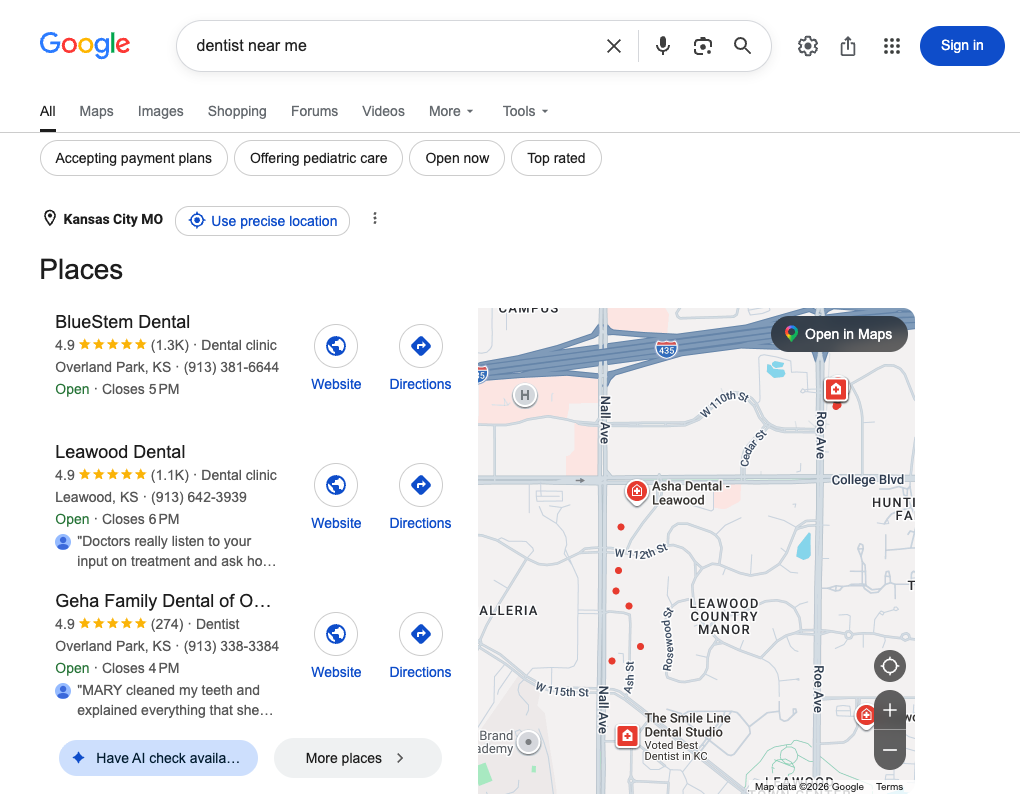
One dimensional searches like "Dentist near me" only allowed the searcher to specify one preference.
This would then require further research including looking through multiple websites, making calls, reviewing third-party reviews, all to create a short-list of choices for their new dental home.
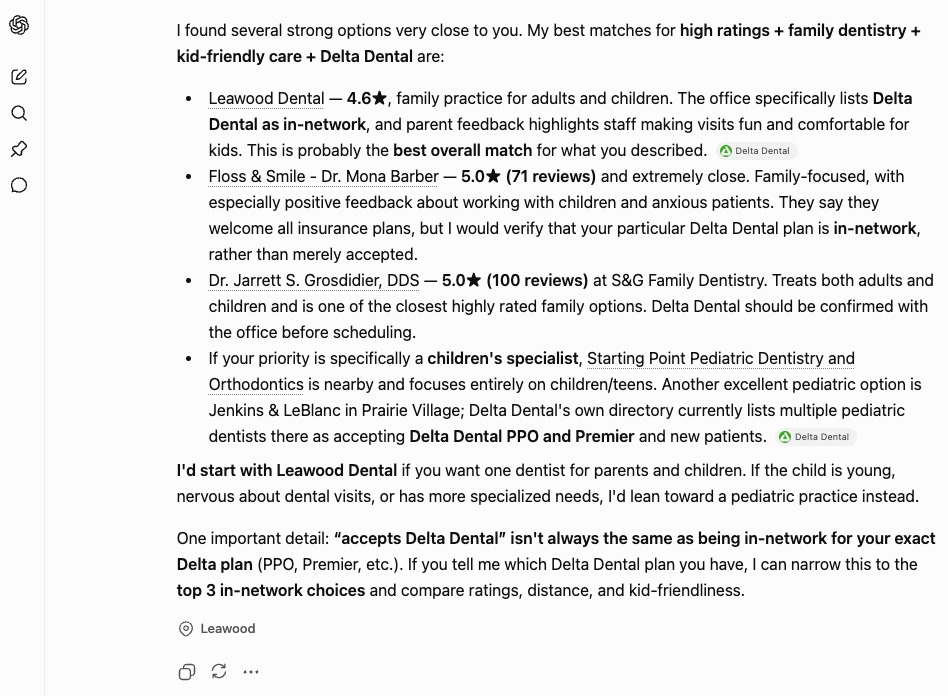
ChatGPT and other AI platforms started training searchers they can shortcut all of this research with one search:
"Highly rated family dentist near me who accepts Delta Dental and is good with children."
These searches were rewarded with results like the one below replacing hours of research with one single personalized result.

As patients search using more preferences, results become personal to the individual searching.
A dentist may have 1,000 five-star reviews and rank prominently for "dentist near me." But if a patient needs a dentist who accepts Delta Dental and the practice never clearly states that it does, the practice may not appear among that patient's best matches.
Another dentist with fewer reviews may be surfaced instead because the platform can verify that it matches more of the patient's specific preferences.
The "best dentist" is no longer necessarily the practice with the strongest traditional ranking signals.
It is increasingly the practice that best matches the searcher's location, insurance, treatment needs, and any of the hundreds of other factors that make a dentist the obvious choice.
This leads to the third shift…
Traditional ranking factors such as links, content, and technical optimization still matter.
But they are increasingly coming second to new signals used by AI-powered search engines to create hyper-personalized results.
These signals ladder up to three criteria:
So how do you ensure you are matching this criteria?
This framework needs to be more than a checklist of standard SEO tasks. It needs to do five things very well.
A fee-for-service cosmetic patient has different priorities than a family looking for an in-network dentist. An implant patient may evaluate your practice differently from someone seeking routine preventive care.
Each patient profile documents the needs, preferences, concerns, and decision factors likely to shape that patient's choice.
These profiles become the foundation of the marketing strategy, influencing everything from search targeting and website content to photography, messaging, and design.
Without these ideal patient profiles, you won't know what to optimize.
Your ideal patients have a journey with many choices along the way.
These choices could lead them to your practice or the competitor down the street.
Where is your practice failing to appear in this journey? Where is the fit unclear? Where are competitors providing stronger evidence? Where might patients lose confidence or abandon the process?
You must find the gaps preventing your practice from being found, investigated, and ultimately chosen.
Create, capture, or strengthen the evidence patients and platforms need to make their choices.
Depending on the practice, this may include treatment content, dentist credentials, reviews, testimonials, photography, before-and-afters, insurance information, technology, professional affiliations, local recognition, or a clearer explanation of the patient experience.
The exact evidence depends on your ideal patients and the factors that matter to them.
Strong evidence only helps if it appears in the right places.
You must distribute and reinforce it across the website, Google Business Profile, reviews, directories, social platforms, professional profiles, local publications, and other sources influencing visibility and patient choice.
This helps search platforms verify your relevance while ensuring patients encounter the right proof at the right time.
That means looking beyond isolated rankings to evaluate qualified visibility, search-result engagement, website behavior, calls, forms, appointments, and business impact.
Those insights reveal what is working, where patients are still being lost, and which opportunity should be addressed next.
Becoming the obvious choice requires more than completing a checklist. The Obvious Choice Framework evaluates seven drivers that influence whether your practice is found and chosen by both search platforms and prospective patients.
Can your ideal patients find your practice?
Before your practice can be chosen, it must appear in the initial set of results. This is where traditional SEO still shines. The framework starts with a 100-point SEO audit covering:
Does your practice match what your ideal patient is looking for?
Appearing in search results is not enough. Google, ChatGPT, and prospective patients must recognize that your practice matches the specific preferences behind the search, including treatment, insurance, location, patient type, technology, philosophy, scheduling, and financial options.
A practice may be qualified to serve a patient but still be excluded if that fit is not clearly documented.
Why should the patient choose you instead of another relevant option?
Relevance earns your practice a place among the options. Differentiation gives the patient a reason to prefer it. Meaningful differentiation may come from:
Can patients and search platforms verify your claims?
It is easy to claim your practice is the best choice. Credibility provides the proof. It can be established through:
Is your evidence clear, compelling, and easy to understand?
Having the right information is not enough. How it is presented influences whether patients notice it, understand it, and believe it.
Strong presentation brings together clear messaging, professional photography, intuitive page structure, scannable treatment information, prominent proof points, and a consistent brand experience.
Does patient interest turn into a call?
Once a patient believes your practice may be the right fit, taking the next step should feel easy and low-risk. The framework evaluates:
Does the actual patient experience fulfill the promise?
Getting chosen is not the end of the process. The experience patients receive determines whether the practice earns lasting trust, repeat visits, referrals, and positive reviews, and increasingly helps search platforms assess whether your practice delivers on its claims.
Each driver builds on the one before it. A weakness in any one driver can undermine the entire journey.
You can rank without being relevant. You can be relevant without being different. You can be different without proving it. You can have compelling proof and present it poorly. You can persuade the patient but make contacting the practice difficult. You can generate the appointment but fail to deliver the experience promised.
The Obvious Choice Framework identifies where that chain is breaking and prioritizes the improvements most likely to help your practice get found and chosen.
Each of the following practices faced a different challenge: discoverability, differentiation, credibility, or relevance. The framework identified the gaps and addressed them systematically.
As a fee-for-service practice, Smile Line Studio needed a different kind of patient: someone who sees dental care as an investment in their long-term health and appearance, and who chooses a provider based on trust, expertise, and experience rather than what their plan will cover.
That started with building a clear picture of who this patient is, how they think about dental care differently, and where they go when they are ready to make a decision. The messaging was built to meet them there.
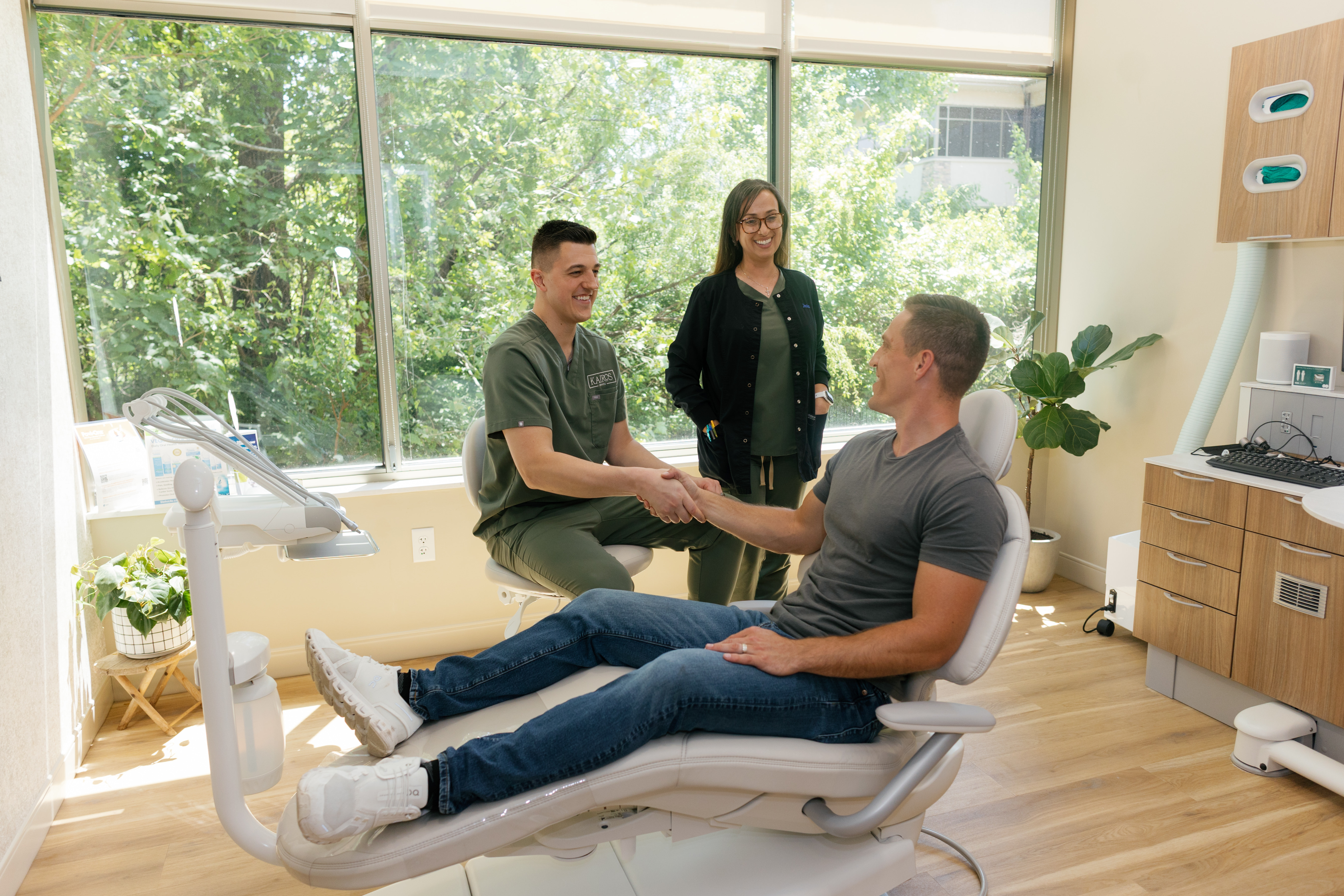
Kairos needed more than visibility for broad dental searches. It needed to become unmistakably relevant to patients looking for holistic dental care with specific concerns about materials and treatment protocols.
We aligned the brand, domain, Google Business Profile, website, and treatment content around ceramic implants, SMART mercury filling removal, biological extractions, ozone therapy, and PRF, giving both patients and search platforms clearer evidence of who the practice serves and why it is different.
When a patient types "Delta Dental dentist in Sarasota," they are not browsing. They have a plan, a preference, and they are ready to choose.
We built custom pages around specific insurance plan searches, putting SRQ Smiles directly in front of those patients. Because each page was built to satisfy every driver at once, they surfaced in AI-generated results and converted at a high rate when patients arrived.
Standing out as the obvious family-friendly practice takes more than putting "family" in your content. Floss & Smile was built to signal warmth and approachability at every touchpoint: a name patients remember, a color palette that feels relaxed rather than clinical, and messaging that spoke directly to parents making decisions for their whole household.
The result was a practice that felt like a match before the first appointment was ever booked.
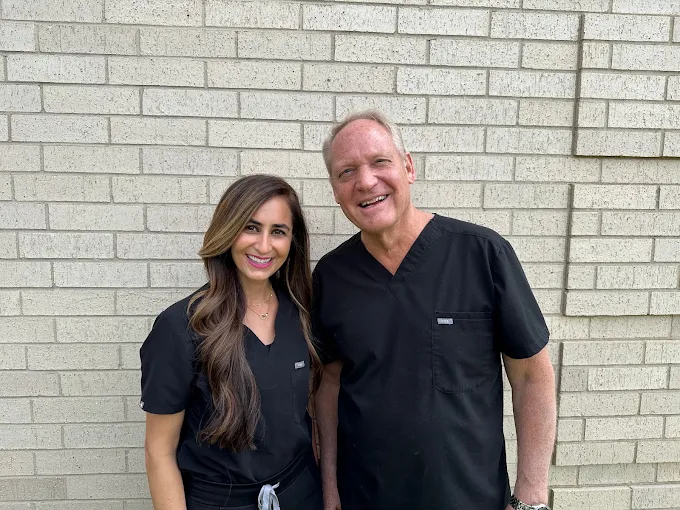
"Starting a practice in a crowded market meant I needed to stand out from the beginning. Frank's SEO gives me an edge other businesses don't have."
Dr. Mona Barber · Floss & Smile
Your practice may already provide exceptional care. The question is whether patients and search platforms can find enough evidence to recognize it.
A discovery call is an opportunity to discuss:
You do not need another collection of disconnected SEO tactics. You need a strategy for becoming the obvious choice.
Schedule a Discovery Call